
When Trust Is Shaken: The Psychological Dimension of the Crisis of Institutions


By Melina Tzakou, Psychologist—Psychoanalytic/Psychodynamic Psychotherapist, Founder & Scientific Director of the Arkesis Mental Health Center
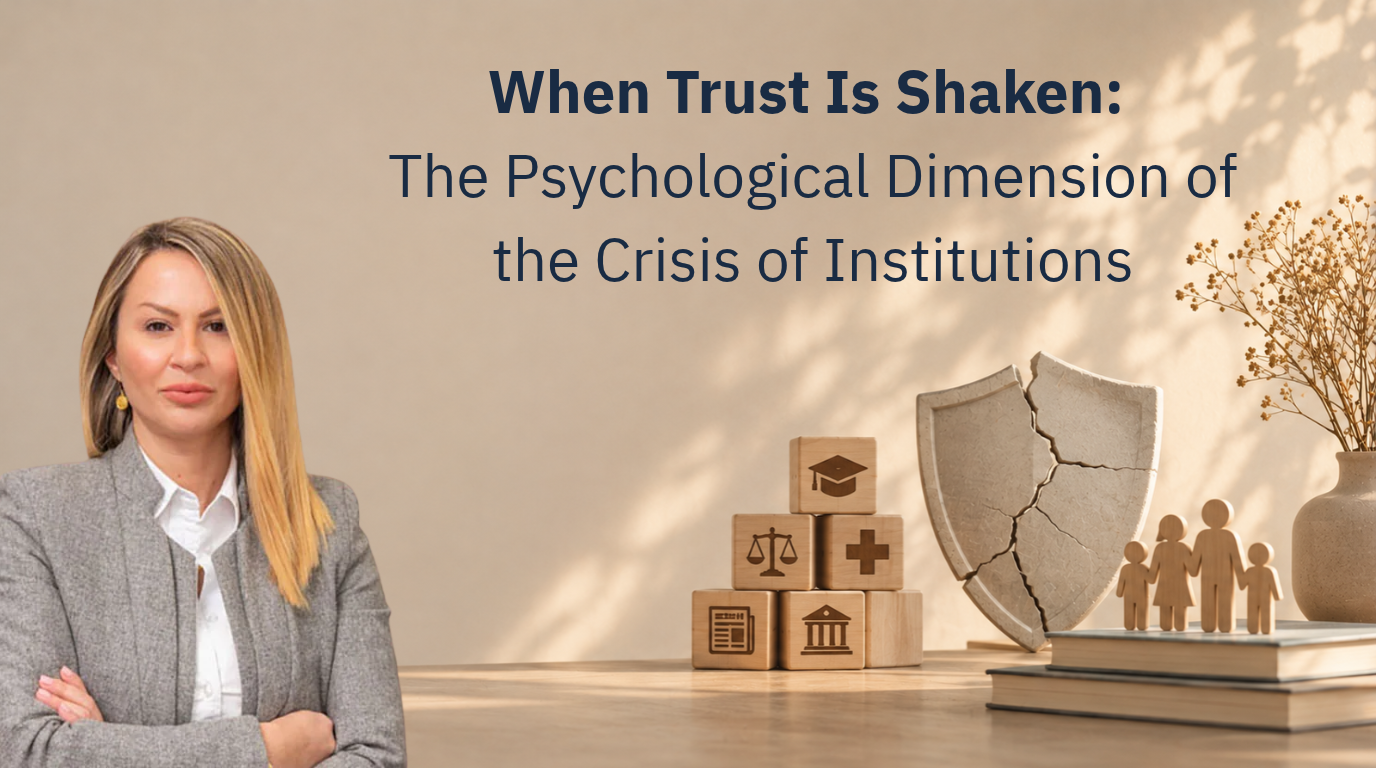
Trust is the foundation of psychological development and social cohesion. In today’s societies, institutions such as the school, the family and the medical community act as pillars that shape our shared experience and provide a sense of safety and stability. When this trust is lost, however, the psychological and social consequences are profound, and they often make it harder for individuals to form relationships, to endure hardship and to hope.
Basic Trust and the Roots of the Crisis
The concept of basic trust, as developed by Erik Erikson (Erikson, 1963), is situated in the first critical stage of life. Through the relationship with their parents, the infant learns to trust the world or, if care is inconsistent or impersonal, develops a basic mistrust. This primary experience shapes the individual’s later capacity to relate to people and institutions. If parents therefore transmit to their children mistrust, or even contempt, toward institutions such as the school, the justice system or science, the child grows up without the psychological foundation needed to withstand life’s difficulties and disappointments.
The crisis of basic trust is evident today on many levels. Parents often fail to help their children bear and tolerate difference, opposition and hierarchy. Instead of helping the child to manage a sense of injustice or frustration (an unavoidable experience in any structured system), they hasten to challenge the institution, such as the teacher, and to shield the child from any discomfort. The result is a weakening of psychological resilience and a gradual erosion of trust in every form of authority.
The Decline of Respect for Teachers
One of the most visible signs of the crisis of trust in institutions is the loss of respect for educators. The teacher, once a model of authority and knowledge, now experiences disparagement not only from students but often from parents themselves. Questioning of the teacher’s judgment, frequent parental interference in educational matters, and the ease with which a child can bypass the school’s hierarchy all undermine the teacher’s institutional standing.
This attitude has significant psychological consequences. A child who does not learn to respect hierarchy struggles to tolerate disappointment, to manage a sense of injustice and to develop self-discipline. According to psychoanalytic developmental theory (Freud, 1923; Klein, 1957), the acceptance of difference and limits is a prerequisite for the formation of identity and the capacity for coexistence. When adults fail to support the institution of the teacher, however, they convey to the child the message that every form of authority is negotiable or even unnecessary.
Distrust of Doctors and Its Consequences
Another characteristic example of the contemporary crisis of trust is the attitude toward the medical community. The spread of conspiracy theories, the questioning of scientific knowledge and the turn to unapproved and often dangerous treatments are phenomena with serious consequences for public health. The psychoanalyst Winnicott (1960) notes that trust in the specialist presupposes an internalized experience of safety and protection. When this experience is lacking, the individual finds it hard to hand over control, to accept care or to follow instructions they do not fully understand.
Distrust of doctors often leads people to seek “alternative” treatments or improvised solutions, while overlooking the dangers of such choices. The psychoanalytic approach would interpret this attitude as a defense against the anxiety of dependence and helplessness: an attempt to maintain control in the face of uncertainty and the fear of illness.
The Crisis of Trust in the State, the Justice System and the Media
Distrust is not confined to the school or to health. It extends to the state, the justice system, the media and even science itself. The sense that institutions operate with bias and do not protect the common good reinforces individualism and isolation. Freud (1930) had already pointed out that the individual’s relationship with civilization is at once a source of security and of restriction. When this balance is disturbed, however, the individual retreats into individual solutions, often at the expense of the common good.
In this context, the spread of false news and conspiracy theories represents an unconscious attempt to restore a sense of control in a world that seems opaque and threatening. Bion (1962), examining groups, describes how, in times of crisis, primitive defenses such as splitting and projection prevail, reinforcing distrust and the sense of threat.
The Impact on Mental Health and Relationships
The loss of trust in institutions has direct psychological consequences. The feeling that no one offers protection, and that there is no stability or justice, generates anxiety, insecurity and often depressive or paranoid feelings. Psychoanalytic theory stresses that trust is a prerequisite for the development of hope and creativity (Erikson, 1963). Without it, the individual becomes trapped in vicious circles of doubt and insecurity, and struggles to form meaningful relationships or to experience a sense of belonging.
At the same time, interpersonal relationships come under strain. When suspicion prevails and every form of limit or authority is challenged, relationships become fragile, superficial and often competitive. Object relations theory holds that an individual’s ability to relate functionally depends on early experiences of trust and security (Klein, 1932; Winnicott, 1965).
A Psychoanalytic Reading of the Crisis of Trust
The crisis of trust in institutions is not merely a social or political phenomenon but a deeply psychological one. Behind every act of challenging or undermining an institution often lies the individual’s difficulty in bearing uncertainty, dependence and the need for limits. The psychoanalytic approach, with its tools for understanding the unconscious, can help us see how distrust toward the “other,” whether the teacher, the doctor, the judge or the state, is ultimately distrust toward oneself, toward one’s own capacity to relate and to endure coexistence.
In conclusion, restoring trust in institutions requires not only structural change but also deep psychological processes. Strengthening basic trust, restoring respect for authority, and cultivating resilience and tolerance of difference are prerequisites for collective and individual mental health. As Erikson (1963) observes, “hope is born from trust.” Without it, every institution, however well constructed, remains empty of content.
Wednesday, 18 November 2026
Services
At our Center, we offer individual and group psychotherapy services for adults, adolescents, and children, couples therapy, parenting counseling, and specialized psychiatric support.

Individual Psychotherapy for Adults
Through the personal process of individual psychotherapy, clients find a safe space where they can speak openly about whatever is troubling them, gain a better understanding of themselves, and find wa
View more
Individual Psychotherapy for Children and Adolescents
Individual psychotherapy for children and adolescents provides a safe and supportive environment, tailored to the needs and challenges of each age group. Through the therapeutic process, children and
View more
Individual Psychotherapy for the Unemployed, Students, and Vulnerable Groups
Psychotherapy is a truly valuable investment in ourselves. However, we understand that the cost can sometimes be a barrier, especially for those who belong to vulnerable groups.
View moreContact Us
Please contact us to discuss any questions you may have about our services or to schedule an appointment.
Hours
- Mon - Fri 9 am - 9 pm
Accesibility
- We provide easy access for people with disabilities, with wheelchair ramps and appropriately designed entrances and spaces.